Posts tonen met het label typewriter. Alle posts tonen

11 december 2022

My Perfected Type Writer № 2, #2518

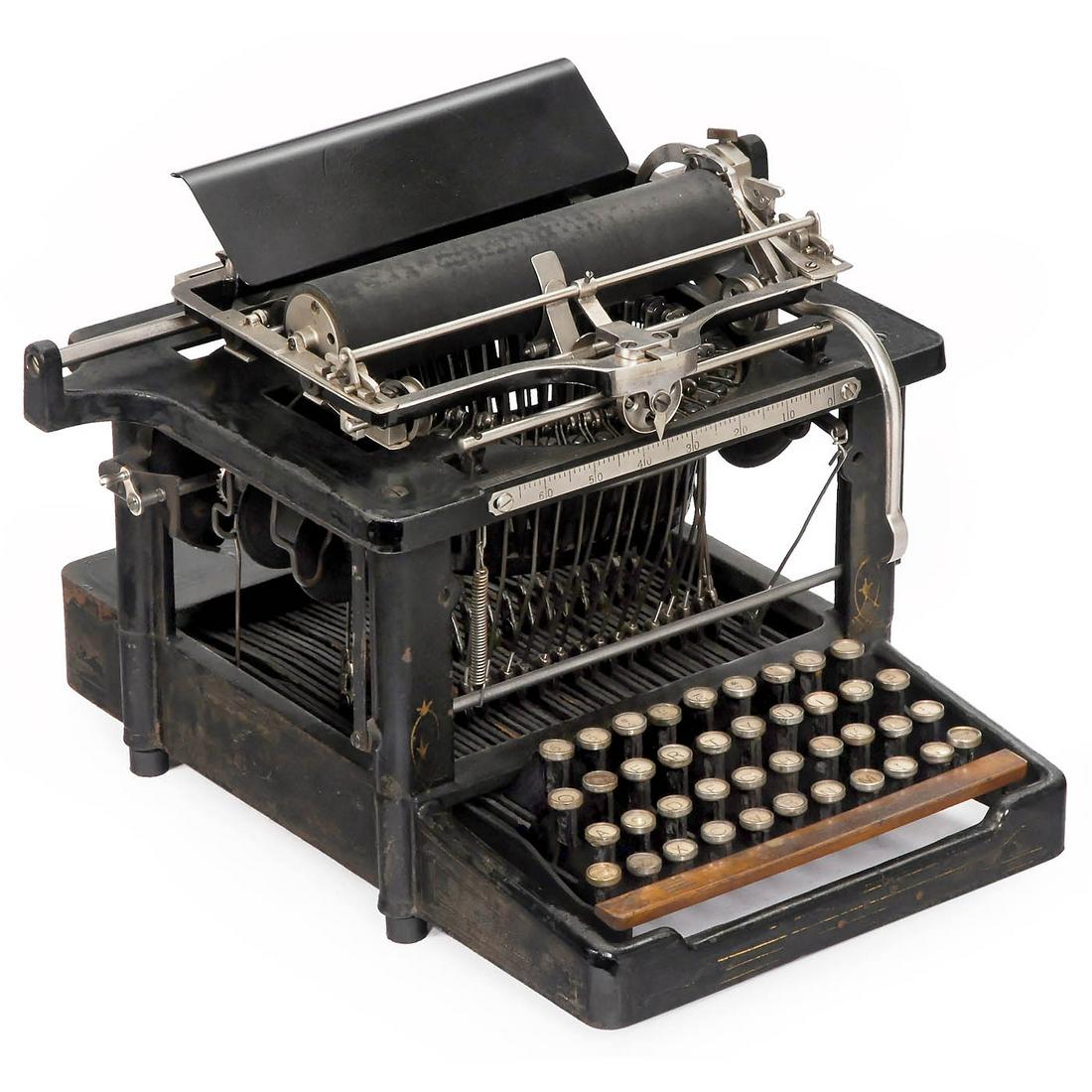
Recently, I bought a machine called “The Perfected Type Writer № 2” (PTW2), with serial number #2518. It belonged to collector Jim Rauen and was sold to me at the Breker Auction in Germany last March 2022. In the auction catalog it was advertised wrongly as a “Remington Standard № 2”.

#2518
Perfected Type Writer No. 2 #2518, picture by Breker Auction

I got it together with a Caligraph No. 2 for in total 450 euro (+23,5% commission cost). Two months later Breker sold another PTW2, with serial number #6854. This time it was advertised correctly as such, and therefor sold for 2000 euro.
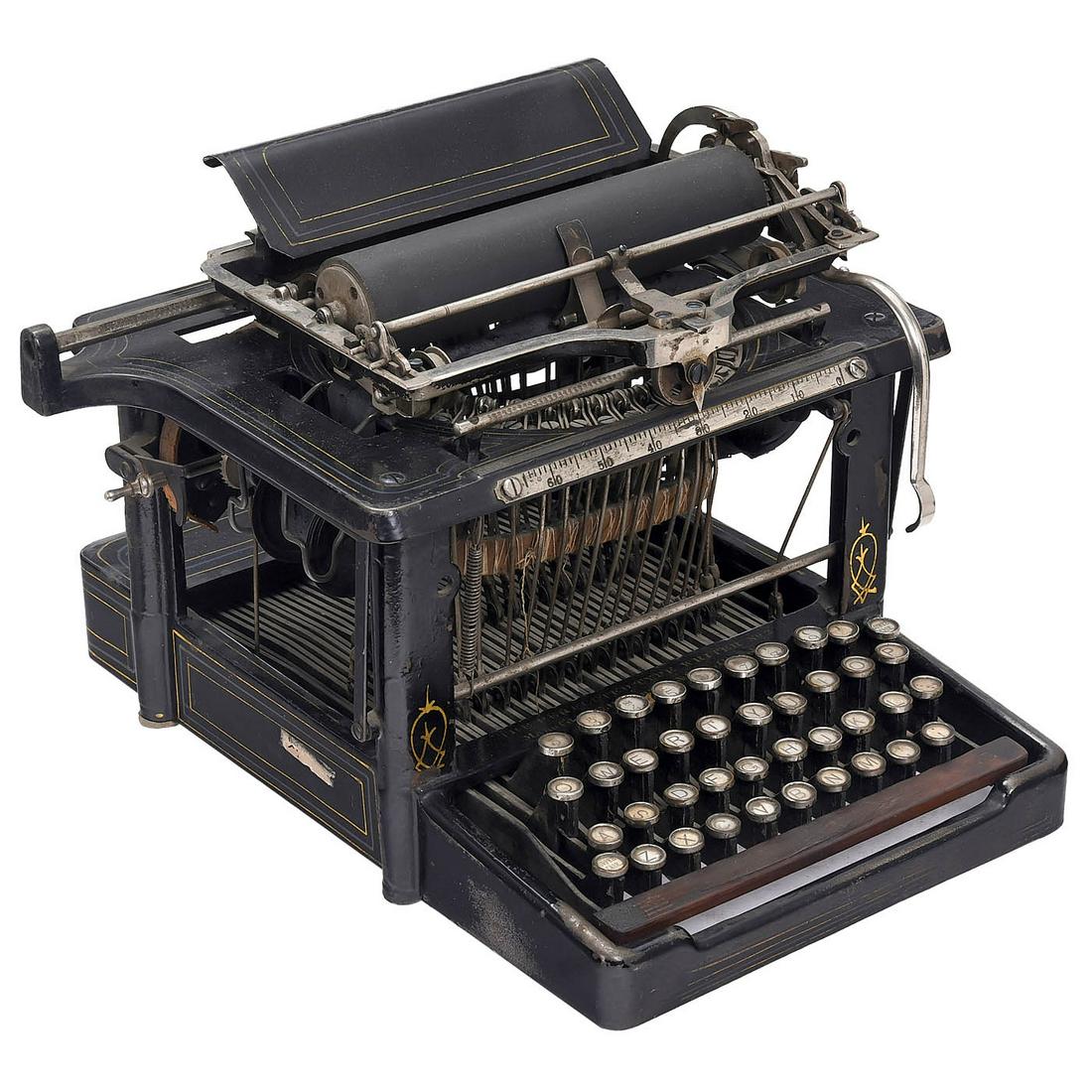
Perfected Type Writer No. 2 #6854, picture by Breker Auctions

The latest version of the Sholes & Glidden was called “The Perfected Type Writer”, and the PTW2 is the successor of that machine, and the first typewriter with a shifting mechanism. After this came the Standard Type-Writer № 2, which finally became the Remington Standard № 2. I had a Standard Type-Writer № 2 as well; see: https://schrijfmachine.blogspot.com/2020/05/this-is-not-remington-typewriter.html

Decal above keyboard of PTW2 #2518

The quickest way to identify a PTW2 (apart from the decal above the keyboard) is by looking at the center wheel, just above the metal paper scale in front of the carriage. All PTW2’s I have seen have a shifting mechanism above the center wheel in front of the carriage. From the Standard Type Writer № 2 onward, the shifting mechanism changes, and the part above the center wheel is not connected to a shifting construction anymore.

Center wheel and shifting part on top of it. PTW2 #2518

So far I have found 7 PTW2’s, all within the serial number range of #2518 to #7190. However, there is a picture of an 8th PTW2 in a book from 1964 about the typewriter collection of the Science Museum of London. That machine is also pictured in Beeching’s book (The Century of the Typewriter, 1974). According to the online museum catalog, this machine has number #593, and I believe this is indeed a serial number.
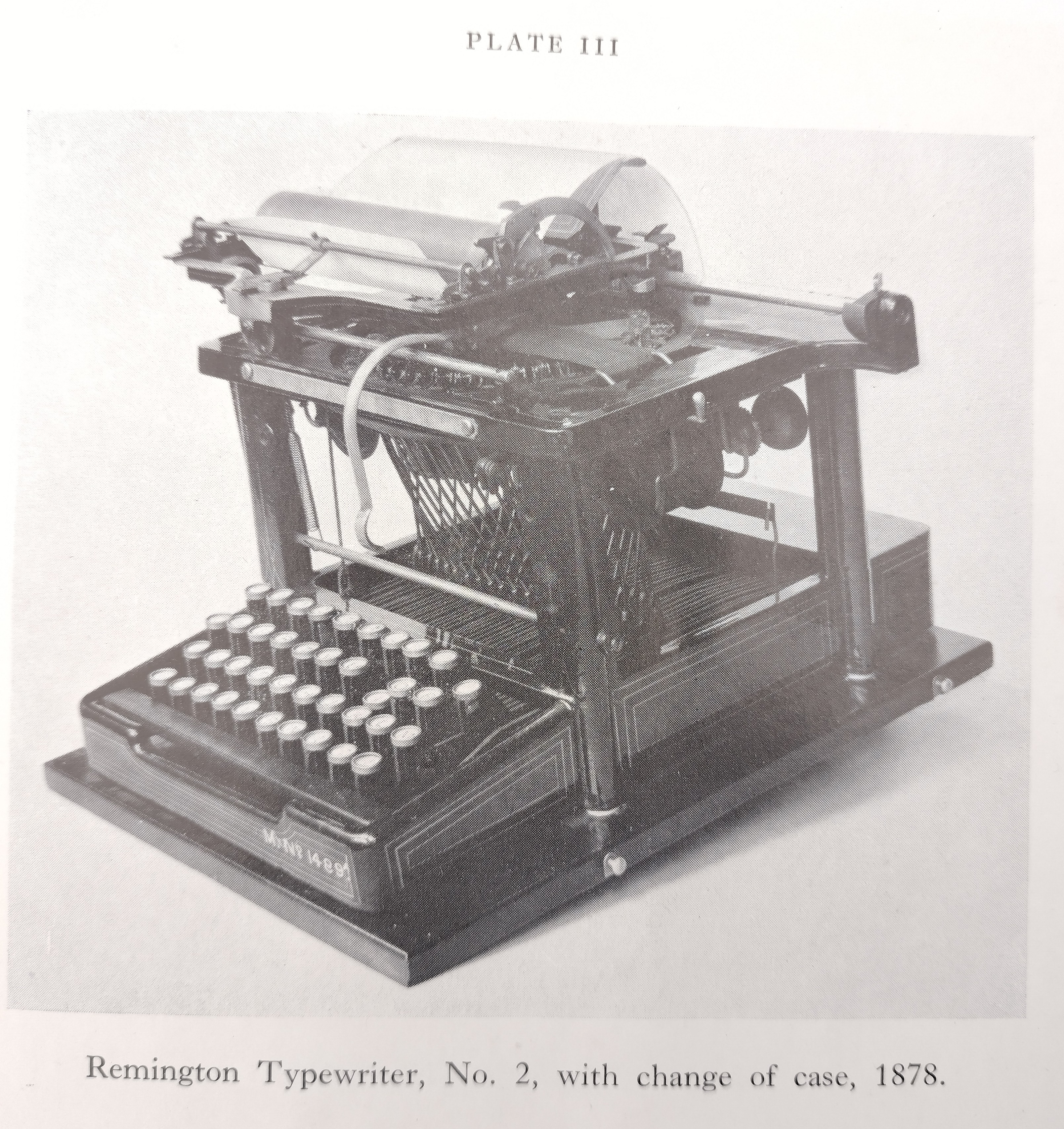
PTW2 #593 from the London Science Museum. Picture from museum catalog, 1964. Notice the lack of a decal above the keyboard. Above the right shift key there is only a pin stripe visible.

From the old picture in the book, it looks like this machine doesn’t have the name “Perfected Type Writer № 2” above the keyboard. This is just like the very early Perfected Type Writers № 4, which don’t have any designation either, only pinstripes above the keyboard; see for example PTW4 #575. Unfortunately, the London Science Museum has ignored my mails (and even a letter) asking for more information.

Cast iron type basket of PTW2 #2518.

The PTW2 from the London Science Museum (#593), my machine (#2518) and a later specimen (#2654) have a cast iron type basket, similar to the type baskets of the Sholes and Gliddens and early Perfected Type Writers № 4. See for example this S&G

Cast iron type basket of a Sholes and Glidden Type Writer


Later PTW2’s, like the PTW2 #6854 that was auctioned by Breker last May, have a different typebasket, made of metal wires. This is similar to the construction used in later machines, like the Remington Standard № 2.

PTW2 #6854, notice the lack of a cast iron type basket

My Perfected Typewriter № 2 #2518 has two more peculiarities: it has both shift keys (upper case  on the left and lower case on the right) at the lower bank of the keyboard, just above the space bar. All other specimens I know of have the lower case key at the right on the upper bank of the keyboard. Just like on later name variants of this machine. No other PTW2 I know of has both shift keys at the lower bank of the keyboard. My machine was far ahead of its time!

Lower case key of PTW2 #2518, at the bottom of the keyboard

The second peculiarity of my machine is the “r.”-key. That’s right, a single key for two characters: the “r” and the period. It is located as uppercase character above number “5”. When searching the web for more information about the Perfected Type Writer №. 2, I stumbled upon an interesting article from Marcin Wichary about this key. Here is a quote from the article, explaining the use of this key:

“In such abbreviations as Mr. or Dr., the small letter r and period can be made with one touch by using the fourth key from the left in first row. […]

Why dedicate half a key to something so obscure, and something that looks exactly the same as typing r and . separately? The answers to both, as it turned out, required just a bit of context.

This [the Perfected Type Writer № 2) was among the first typewriters with shifting, and shifting was hard – split between Upper Case and Lower Case keys on the opposite sides of the keyboard, and requiring a lot of force to lift a heavy mechanism. Putting r. in a shifted position was a stroke of genius – in common usage (e.g. Mr. Wichary) it followed an uppercase letter, and was immediately followed by another one, so this saved a few shifts and unshifts along the way.”

Source: To save a keyboard, pt. 1 | Revue (getrevue.co)

Author Marcin Wichary is writing the book “Shift Happens”, which will include a picture of my machine.

"r."-key of PTW2 #2518

As far as I know, the r.-key was only used for a short period of time on the Perfected Type Writer № 2. I have only seen it on my machine and on machine #2654.

Do you own a Perfected Type Writer № 2? Please leave a comment below.


09 februari 2021

Earliest Remington Portable 1 typewriter

Remington Trade Catalog January 1921. Notice that although the letter in the machine is dated August 1920, the machine has integrated feet, like later machines. 

In the Fall of 2017, I wrote an article about the earliest known Remington Portable typewriter, with serial number NC00099. This serial number stems from October 1920. In fact, it means it was machine number 99 from that month. You can read the full article in Etcetera, which is a free PDF download: https://etconline.org/backissues/ETC118.pdf 

As you can read in the article, I compare the earliest known Remington Portable NC00099 with a later machine, NA00346, made in December 1920. The pictures in the magazine are of low resolution, so I decided to put them here, on my personal typewriter blog. For differences between December 1920 machines and later ones, see Richard Polt's excellent overview

Although the Remington Portable was presented to the public in October 1920 and no earlier machine than NC00099 is known, Remington started production of the new portable typewriter as early as late 1919. It could be that those 1919-machines were stamped with a serial number in October 1920, but there might as well be machines with serial numbers before October 1920! Keep your eyes open. 

If you want to find out in which year and month your Remington Portable typewriter was made, click here.

On a side note: both machines are not in my collection anymore.

Okay, now the pictures! 


NC00099 on the left, NA00346 on the right

The most interesting difference between the 1920 machines is the way they are attached to the case and rest on their feet. NA00346: as with most other 1920 and early 1921 machines, the base of the carrying case has studs that pass through two small holes in the front corners of the typewriter. The cotter pins that attach this machine to the base through holes in the studs are missing. When on the desk, the typewriter is resting on four “feet,” which are an integrated part of the frame of the machine.

NC00099 on the left, NA00346 on the right

NC00099: The four metal feet are not an integrated part of the frame of the machine, but are welded or glued on it. In addition to the two small holes in the front corners of the machine, this typewriter has two similar holes in the back corners. 

NC00099

NA00346

The springs that attach the keys to the machine are far less secured on NC00099 than on NA00346 and later machines.

NC00099

NA00346

NA00346 has a wooden space bars. NC00099 has a plastic one. This is possibly a later replacement, as later machines had plastic space bars as well.

NC00099

NA00346

The platen knobs (and the way they are fixed to the platen) are different on both machines.

NC00099

NA00346

The inner works of NA00346 has more nickel-colored parts. NC00099 has more blackened parts.

NA00346

NC00099

It’s also worth mentioning the change in design in the Remington logo. NC00099 has a smaller, simpler illustration of the Remington understroke typewriter. The logo of NA00346 is scratched out. Later machines have a bigger and more detailed illustration of the Remington understroke typewriter.

NC00099

NA00346

The paper tables have the same dimensions, but are bent in a different way. 
NC00099

NA00346

Both machines were first painted and than stamped with a serial number.

NC00099

NA00346

The case of NC00099 is totally different from any other Remington portable I have seen. It is bigger, green, and probably never had a handle. It might be a custom made case, with some parts of an original Remington portable case.

NC00099

NC00099

The cylinder scale of NC00099 has smaller, but clearer numbers than NA00346. This might have been replaced later on. There is no line gauge on NC00099. It is present on NA00346, so it is probably just missing on the earlier machine.

NA00346

NC00099


NA00346 (left), NC00099 (right)

The keys on NC00099 look tired, as if the springs can’t handle the weight of the keys after almost a century. NA00346 doesn’t have this problem.

NC00099 (left), NA00346 (right)

NC00099 (left), NA00346 (right)


Here are the original Ebay pictures of NC00099:

NC00099

NC00099

NC00099

NC00099

NC00099

NC00099

NC00099

NC00099

NC00099


03 mei 2020

Hammond typewriter 2

Last year, I sold all my antique typewriters. I gradually lost interest and I wanted to free some space. Recently, however, I started to look for typewriters again, focusing mostly on the typewriters I never had. I bought a Remington Standard 2 and, last Friday, a pristine Hammond 2.

Almost ten years ago, I wrote a little article about Hammond typewriters in The Netherlands, see: https://etconline.org/backissues/ETC095.pdf. Hammond was a fairly popular machine here. I wrote about the importers of Hammond typewriters. According to the shield on the right side of the machine, this specimen was imported by G.H. Voorhoeve. This was several years before Ruys splitted the import of typewriters from the main company in 1904. Later, Ruys became the importer of Underwood and Olivetti.

The serial number of this machine is 27766, which makes it a very early model 2, from around 1895. Several details, like the paper basket, the line spacer, the paper table and the carriage wheel, are the same ones as used on models 1a and 1b. The metal tab on the front is the most obvious sign it actually is a model number 2.

Under the metal tab is a mysterious part that I haven't seen before. It holds the shuttle down, so the written text could be read without having to hold the finger on the metal tab. But I am open for other suggestions.


I bought the machine in Bergambacht, a small Dutch village on the border of the river Lek. The seller is the grandson of Pieter Vos, born in 1876, who was tailor in a village nearby: Lekkerkerk. Apparently, Pieter Vos sailed regularly to the city of Rotterdam (20 kilometers over the river Lek), so it is possible he bought the typewriter there. G.H. Voorhoeve sold Hammonds in Rotterdam, so that's possible.

However, according to his grandson, tailor Pieter Vos used the Hammond in the 1920s and 1930s as a secretary of the local shopkeepers association in Lekkerkerk. As this machine was made around 1895, I don't think Pieter Vos was the first owner; he would have been very young by than (19 years). Pieter Vos died in 1967. His son inherited the Hammond and kept it till he died himself in 2013 (98 years of age). The seller was the next in line to receive the typewriter, but his children didn't want it, so I could buy it.

I made a video to show how it works:


It is the best conserved Hammond 2 I have seen so far. Everything is there and shiny: the original ribbon spools, the little metal part on the paper table that activates the bell, even the original impression strip is still doing its job. The keys are not damaged and the case is still beautiful.

It is the third Hammond I own (after an ideal Multiplex and a Folding Multiplex), and I am amazed by the quality of this machine. Everything seems made to last forever. A lot of small parts seem custom designed for this machine, it's all very ingenious and well thought. The pictures don't do it justice, but I hope you enjoy them anyway.