25 mei 2013
German typewriter Collectors Meeting, May 25 2013, Köln
Today I went to another meeting of the German typewriter collectors in Köln. It was nice to see familiar faces and to practice German while walking past the trunks of the cars, filled with all kinds of typewriters. Here are the pictures, so you get an idea. I had the impression that most sellers had to take the vast majority of their machines back home again. Only those who put "realistic" prices were able to sell some.
12 april 2013
Did I just receive an Underwood 2?
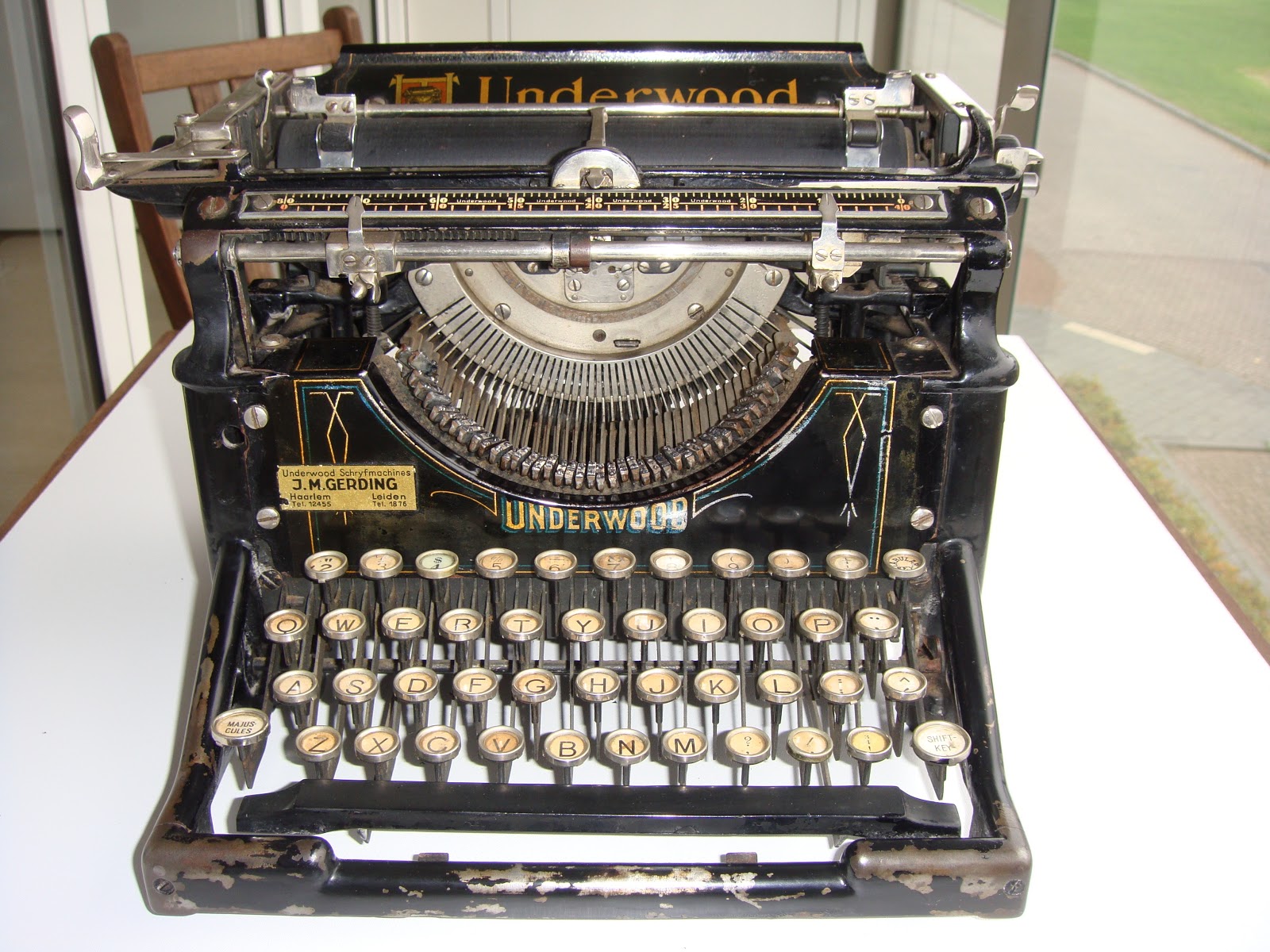
I've just received what I believe is an Underwood 2. I bought it from an antiques dealer on the internet, who thought it was from the 1940s. If this is really a #2, it would've been made in or around 1898.
It looks like an Underwood 1 (no see-saw ribbon color selector and a metal colored scale strip) but it has 42 keys instead of 38, so - according to Ernst Martin (1923), p. 218 - that would make it a #2. The serial number is 9732. There is no patent information on the back (no mention to Wagner, nothing).
I haven't found a lot of information yet about this machine or its rarity, except for a message in the Yahoo typewriter mailing list from 2002, claiming that only 2 other Underwood #2's were known. So, logically, I am very excited about this find. Is this really an Underwood 2? And if so, is it really that rare? Anyone else owns an Underwood 2? What is the serial number?
If anyone reading this has more information about the Underwood 2, please write me a comment below or click here to answer the mail I've sent about this typewriter in the Yahoo typewriter mailing list. Now, I probably better start cleaning it. Carefully, just in case!
Here are the pictures:
It looks like an Underwood 1 (no see-saw ribbon color selector and a metal colored scale strip) but it has 42 keys instead of 38, so - according to Ernst Martin (1923), p. 218 - that would make it a #2. The serial number is 9732. There is no patent information on the back (no mention to Wagner, nothing).
I haven't found a lot of information yet about this machine or its rarity, except for a message in the Yahoo typewriter mailing list from 2002, claiming that only 2 other Underwood #2's were known. So, logically, I am very excited about this find. Is this really an Underwood 2? And if so, is it really that rare? Anyone else owns an Underwood 2? What is the serial number?
If anyone reading this has more information about the Underwood 2, please write me a comment below or click here to answer the mail I've sent about this typewriter in the Yahoo typewriter mailing list. Now, I probably better start cleaning it. Carefully, just in case!
Here are the pictures:
01 april 2013
31 maart 2013
09 maart 2013
Yost 1 typewriter
My latest
typewriter acquisition came in with quite an attitude. The other typewriters
didn’t understand. It was old, produced in 1888, but since when was that
something to brag about? It was relatively rare and well, it had a fancy
mechanism, but most typewriters in my display have a not so ordinary way of
typing. So, why the attitude?
My other
typewriters couldn’t know, but the Yost 1 I bought last week is famous. For
decades, Michael Adler’s “The writing machine” has been the best typewriter
book around (after Martin’s “Die Schreibmaschine” of course, but Martin didn’t
publish pictures). “The writing machine” was first published in 1973 and
contains the most important facts about each and every machine that was ever
made or patented. So, if you were a collector in the 1970s or 80s and wanted to
see a picture of a certain typewriter, instead of using Google, you
consulted Adler’s bible.
Many
machines in his book came out of Adler’s private collection. Some years after
publishing the book, Adler sold his collection to the Dutch friar Ferrerius. His collection formed the foundation of Scryption, a museum of
typewriters and other communication equipment. However, because of financial
trouble, Scryption no longer exists and the collection had to be partially
dismantled. One of the machines that had to be sold was the Yost 1 I bought
last week: the machine with an attitude.
So, why the
attitude? Look into p. 177 of Adler’s “The writing machine” and you’ll see a
picture of a Yost 1. Although the picture is in black and white, the paintless
spot in the middle of the space bar reveals its true identity: it’s a forty
year old picture of the very same Yost 1 I bought last week! So, he may have an
attitude, but if you ask me, that’s well justified.
| Yost 1, Adler, "The writing machine" (1973), p. 177. |
![]() |
| Type arms resting against inking pad |
| Type arm moving like a grasshopper |
| Type arm and alignment guide |
| The escapement mechanism (1) |
| The escapement mechanism (2) |
Edit: a video I made of the grasshopper mechanism and the escapement system:
25 februari 2013
Liliput typewriter
For anyone who wondered why the last 2 weeks three (or more?) rare Liliputs have turned up in The Netherlands: it was a featured item in the Dutch version of the Antiques Roadshow, valued at 2000-2500 euros (if in working condition).
"It's a Liliput machine, but not for a liliput price tag", Fred Kats (the specialist).
One week before the recordings of this show, I showed mr. Kats my Junior typewriter, see: http://schrijfmachine.blogspot.nl/2012/09/antiques-roadshow.html
I also asked him kindly to give some more attention to typewriters in future shows. It seems he listened to me!
19 februari 2013
Waarde van typemachine of schrijfmachine
De waarde van een typemachine hangt af van veel
factoren. Allereerst is er een grote verscheidenheid aan merken en modellen. Van
veel merken zijn er, zelfs al vóór de Tweede Wereldoorlog, letterlijk miljoenen
verkocht. Veruit de meeste typemachines in Nederland zijn dan ook niet
verzamelwaardig. Dat wil zeggen: er zal normaliter niemand bereid zijn er meer
dan 50 euro voor te geven; meestal (fors) minder en vaak helemaal niets. Hieronder
geef ik een (niet volledige) lijst van typemachines die respectievelijk niets, een paar
tientjes, of 100 euro of meer waard zijn.
![]() |
| Een Underwood 5 uit 1904. De typearmen slaan van voren tegen het papier. Van dit model zijn er miljoenen gemaakt. Huidige waarde: ongeveer 20 euro. |
Typemachines die bijna niets of niets waard
zijn
Dit geldt voor bijna alle na-oorlogse
typemachines en voor vrijwel alle vooroorlogse
modellen van Underwood, Remington, Woodstock, Royal, Olympia, LC Smith, Continental,
Mercedes, Olivetti, Torpedo, Alpina, Triumph, Hermes, Rheinmetall, Adler, Optima,
Halda, Erika, en Corona. Al deze typemachines lijken mechanisch erg op de
Underwood 5. Dat wil zeggen, de typearmen
slaan van voren tegen het papier (zie foto).
| Een kleine inklapbare Corona 3 uit 1919. Ook bij deze machine slaan de typearmen van voren tegen het papier. Van dit model zijn er 700.000 gemaakt. Huidige waarde: ongeveer 30 euro. |
Typemachines die een paar tientjes waard zijn
De meeste verzamelaars willen merken en
modellen met een apart mechanisme, zoals typemachines met typearmpjes die niet
van voren, maar van boven, achter of onder tegen de rol slaan, of die met een
typewiel of ander element de letters op het papier zet. Deze machines zijn
meestal al wat meer waard. Een Hammond, The Noiseless, Mignon, Blickensderfer,
Empire, Oliver, Imperial A t/m D, Rofa, Remington (onderaanslag), Smith Premier
(onderaanslag) of Yost (onderaanslag) brengt op Marktplaats al gauw meer dan 50
euro op, mits de typemachine in goede staat is. Maar ook dan zijn het model,
het serienummer en andere details (bijvoorbeeld de kleur of het
toetsenbordtype) belangrijk bij het preciezer kunnen bepalen van de waarde.
Typemachines die minimaal 100 euro waard zijn
En dan zijn er de nóg zeldzamere machines die
(in goede staat) 100 euro of zelfs (veel) meer dan dat kunnen opbrengen - de
échte collector’s items:
Dat geldt voor de meeste voorloorlogse
indextypemachines (dat zijn typemachines zonder toetsenbord) en, om slechts
enkele gewilde modellen te noemen: de Brooks, Caligraph, Chicago, Commercial
Visible, Crandall, Daugherty, Densmore, Emerson, Fitch, Ford, Franklin,
Granville automatic, Hamilton automatic, Kanzler, Lambert, Moya, Munson, National (onderaanslag), North’s,
Pittsburg 10, Postal, Polygraph, Salter, Sholes & Glidden en Williams. Er zijn vele tientallen bijzondere machines,
maar allemaal hebben ze gemeen dat het mechaniek niet lijkt op dat van een
gewone typemachine, zoals de eerder genoemde Underwood 5.
Ook bij al deze collector’s items geldt dat
model, staat, serienummer en andere details veel verschil kunnen maken bij het
bepalen van de verkoopprijs. Mocht je thuis één van bovengenoemde zeldzame
typemachine hebben staan, of een andere machine met een bijzonder mechanisme,
mail dan voor een vrijblijvende taxatie één of enkele foto’s van de typemachine
naar schrijfmachine@yahoo.nl .
Labels:
Brooks,
Caligraph,
Chicago,
Commercial,
Crandall,
Daugherty,
Fitch,
Granville,
Hamilton,
North’s,
Salter,
schrijfmachine,
Sholes,
taxatie,
taxeren,
typemachine,
waarde,
williams
24 november 2012
Breker Auction and HBW collectors meeting
Nowadays we're so used to buy typewriters online, that we almost forget how collectors used to get their machines about 15 or 20 years ago. Today, I had the opportunity to take a look at the past, at the Breker auction of office antiques in Cologne, Germany. It was my first time at an offline auction, and well, it was quite an experience!
According to some senior fellow collectors, in the old days Breker mainly sold typewriters. Now they sell almost any office equipment but typewriters. Of in total 707 objects, only 18 included typewriters. I wanted to have a go for the Pittsburg 10, but after inspecting it before the auction, I decided it wasn't worth the opening bid of 280 euros: it was rusty and defect.
One of the first lots under the hammer was an Enigma Type A (estimate 15.000-25.000 euros), which was sold for a staggering 35.000 euros. And this was only "one of the highlights"! Just one minute later we discovered why there were so many cameras filming the event: a real Apple 1 was up for sale (estimate 120.000-200.000 euros).
The opening bid was 70.000 euros. Two anonymous phone-bidders were really going for it and within moments the 200.000 euros barrier was passed. The tension in the room increased with every increment of 20.000 euros. It was only at 400.000 euros (!) that one of the bidders had to pass. When the item was hammered down we applauded, hardly believing what we'd just witnessed. I wonder who bought the item!
Here is a video about today's auction of the Apple 1 (in English).
After half of the public and all cameras had left the room, the typewriters were up for auction. Three very nice colored Underwood portables were sold for only 100 euros: a Smith Premier 1 reached a hammer price of 240 euros; a beautiful Crandall remained unsold (opening bid 3.800 euros), and "my" Pittsburg changed owners for 750 euros. Way too much if you ask me. Here you can find the list of all realized prices. Scroll down to item 66 and onwards to see the typewriters.
After the auction, Jos Legrand advised me to drive to a meeting of German typewriter collectors at the local Tennis Club. He told me some collectors would sell typewriters out of the trunk of their cars. I expected to find some Coronas/Underwoods/Remingtons, and maybe (if lucky) some Blicks, Yösts or Hammonds. Well... I was wrong!
There were around 20 or 30 cars with each around 5 or 10 typewriters. I spotted a Blickensderfer, Oliver, Densmore and Franklin in the first car. That was promising! I started walking and could not believe my eyes: a Columbia 2, a North's, a Fitch, a Gardner, all in open car trunks, barely protected against the cold German weather... The Fitch (my dream machine) had a 13.000 euro price tag. I wonder whether there were people walking around there ready to pay that kind of money out of their pocket.
Inside the Tennis Club I met Wolfgang Mock and Norbert Schwarz of Historische Bürowelt (HBW). I bought all 80-something past issues of HBW from Wolfgang and subscribed as a member (I guess I really have to improve my German now).
In the back of the room, three fully restored typewriters were standing on a table: a North's, an Emerson and a Sholes Visible, all in mint condition (or even better). After following Richard Polt's very entertaining and interesting blog series about the restoration of his Sholes Visible, I couldn't resist asking the owner to give me a live demonstration of the mechanism of this beautiful typewriter. Now I finally understand how it works! The owner, by the way, appeared to be Hermann Kerz, who has restored many typewriters to mint condition. Very impressive.
It was very nice to have witnessed a real offline auction, but I think next time I'll drive directly to the meeting of German collectors. I didn't know there are so many fellow collectors on such short driving distance. Ah, and next time, I'll definitely bring my camera...
According to some senior fellow collectors, in the old days Breker mainly sold typewriters. Now they sell almost any office equipment but typewriters. Of in total 707 objects, only 18 included typewriters. I wanted to have a go for the Pittsburg 10, but after inspecting it before the auction, I decided it wasn't worth the opening bid of 280 euros: it was rusty and defect.
One of the first lots under the hammer was an Enigma Type A (estimate 15.000-25.000 euros), which was sold for a staggering 35.000 euros. And this was only "one of the highlights"! Just one minute later we discovered why there were so many cameras filming the event: a real Apple 1 was up for sale (estimate 120.000-200.000 euros).
![]() |
| The Apple 1 |
The opening bid was 70.000 euros. Two anonymous phone-bidders were really going for it and within moments the 200.000 euros barrier was passed. The tension in the room increased with every increment of 20.000 euros. It was only at 400.000 euros (!) that one of the bidders had to pass. When the item was hammered down we applauded, hardly believing what we'd just witnessed. I wonder who bought the item!
Here is a video about today's auction of the Apple 1 (in English).
After half of the public and all cameras had left the room, the typewriters were up for auction. Three very nice colored Underwood portables were sold for only 100 euros: a Smith Premier 1 reached a hammer price of 240 euros; a beautiful Crandall remained unsold (opening bid 3.800 euros), and "my" Pittsburg changed owners for 750 euros. Way too much if you ask me. Here you can find the list of all realized prices. Scroll down to item 66 and onwards to see the typewriters.
After the auction, Jos Legrand advised me to drive to a meeting of German typewriter collectors at the local Tennis Club. He told me some collectors would sell typewriters out of the trunk of their cars. I expected to find some Coronas/Underwoods/Remingtons, and maybe (if lucky) some Blicks, Yösts or Hammonds. Well... I was wrong!
There were around 20 or 30 cars with each around 5 or 10 typewriters. I spotted a Blickensderfer, Oliver, Densmore and Franklin in the first car. That was promising! I started walking and could not believe my eyes: a Columbia 2, a North's, a Fitch, a Gardner, all in open car trunks, barely protected against the cold German weather... The Fitch (my dream machine) had a 13.000 euro price tag. I wonder whether there were people walking around there ready to pay that kind of money out of their pocket.
Inside the Tennis Club I met Wolfgang Mock and Norbert Schwarz of Historische Bürowelt (HBW). I bought all 80-something past issues of HBW from Wolfgang and subscribed as a member (I guess I really have to improve my German now).
In the back of the room, three fully restored typewriters were standing on a table: a North's, an Emerson and a Sholes Visible, all in mint condition (or even better). After following Richard Polt's very entertaining and interesting blog series about the restoration of his Sholes Visible, I couldn't resist asking the owner to give me a live demonstration of the mechanism of this beautiful typewriter. Now I finally understand how it works! The owner, by the way, appeared to be Hermann Kerz, who has restored many typewriters to mint condition. Very impressive.
It was very nice to have witnessed a real offline auction, but I think next time I'll drive directly to the meeting of German collectors. I didn't know there are so many fellow collectors on such short driving distance. Ah, and next time, I'll definitely bring my camera...
12 november 2012
Dutch Typewriter Collectors Meeting 2012
Here I leave you some pictures of the Dutch Typewriter Collectors Meeting in Barendrecht (The Netherlands) today. It was organized by Martin and the theme of the day was "thrust action machines", so we all brought our Adlers, Noiselesses, Empires, etc. We had a very nice afternoon chatting about typewriters and enjoying each others company.
| Back (left to right): Frank, Martin, Jos, Leo, Willem, Ceriel, Wim / Front row (left to right): Jaap, Flip, Diewertje, Cor, Bas. |
| Jaap lectures about the Adler Favorit |
| The Noiseless table |
| Comparing Klein Adlers |
![]() |
| Empires, Crowns, Adlers and anything in between. |
23 oktober 2012
Early Underwood 5 typewriter
As you know, it is quite easy to find an Underwood 5. Over 3.5 million were made to last forever, and most of them still do. Because of space limitations, my collection can't be too big, but of course it has to include "the most successful typewriter design in history". With so many Underwoods around it is quite hard to make a choice. I waited and waited, till the "perfect" Underwood 5 would show up.
Last week I thought I was lucky. On the internet I found an Underwood 5, with serial number 2815-5. This early number indicates that the machine was made during the first year of the production period (1900-1931). It also had a Dutch dealer sticker, and I like to have machines in my collection that were actually used in The Netherlands. The sticker could hardly be from the period (1901), as synthetic adhesives were only used from the 1920s onwards. Well, I thought, that would be something to find out later about.
According to the Yahoo Typewriter forum, the very early Underwood 5's were made by the Wagner Typewriter Company - the inventors of the first Underwood. Franz Xavier Wagner and his son invented the linkage between the typebar and the key lever and related this to the principle of the segment and type guide. This way, they devised the idea of a segment and bars - an idea which has been incorporated in all successful standard and portable typewriters ever since (Beeching 1974, p. 26).
After some negotiation about the price (30 euros), I was finally able to get the machine. Unfortunately, the owner had bought it at a thrift store, so he knew nothing about its history. Back home, I started to clean the machine...
![]() |
| Before cleaning. |
| After cleaning. Notice the left shift key has been replaced by a French one. |
| Before cleaning |
![]() |
| After cleaning |
To my surprise, a regular Underwood decal appeared! No mention is made to the Wagner Typewriter Company. I was baffled at first, but some closer inspection of the serial number revealed the mystery:
![]() |
| 2815-5 or 42815-5. Quite a difference! |
21 oktober 2012
Development of the typewriter
Today I made a video in which I show different typewriting mechanisms out of my collection. I used the slow motion function of my camera to get a clear view of how it works. My collection isn't big enough to show the complete development of the typewriter, but well, it gives kind of an idea. I hope you like it!
Click here to watch it in HD on YouTube: Development of the typewriter
Abonneren op:
Posts (Atom)