24 september 2012
Feira da Ladra, Lisbon, Portugal
Last Sunday, we went to Feira da Ladra (thieves market) in Lisbon. Within an hour, we spotted around 20 typewriters. There was nothing that I wanted to buy, but well, it was nice to have a walk there. After having spotted the first 5 typewriters, I decided to take a picture of every next typewriter I saw in its natural habitat. Here is the result; enjoy!
11 september 2012
Antiques Roadshow
Yesterday, the Dutch version of Antiques Roadshow recorded their program near the village of my parents, in the beautiful castle Huis Bergh in 's Heerenberg.
This was my chance to increase the amount of typewriter airplay on Dutch television! So I brought my recently acquired Junior Typewriter.
The weather was extremely nice, and it wasn't a punishment to wait an hour before we could start. Once we were in, we were sent to the table of Fred Kats, who is a specialist in clocks, watches and instruments. He opened the small box, saw the typewriter and...
...well, to be short, he didn't call for the cameras to share this amazing find. ;)
Instead, he got several Breker Auction books from under the table and asked me to help him search for a Junior typewriter auction. After several minutes, he found a Junior, which was sold together with a Perkeo, for 70 euros. That would make 35 euros for each typewriter, approximately. But he admitted he wasn't a typewriter specialist and thought it should be more expensive than that. He liked the little machine, but couldn't tell me more about it than I already knew.
After this, we went to the other tables. One guy brought a spectacular painting of steamboats in the harbor, but the specialist wasn't impressed. It was made by a painter who dedicated his life to this kind of paintings, so a lot of his work had survived. He valued it at "a couple of thousands euros" before he lost interest and started asking around for sugar in his tea.
![]() |
| Huis Bergh, www.renealberts.com |
This was my chance to increase the amount of typewriter airplay on Dutch television! So I brought my recently acquired Junior Typewriter.
The weather was extremely nice, and it wasn't a punishment to wait an hour before we could start. Once we were in, we were sent to the table of Fred Kats, who is a specialist in clocks, watches and instruments. He opened the small box, saw the typewriter and...
...well, to be short, he didn't call for the cameras to share this amazing find. ;)
Instead, he got several Breker Auction books from under the table and asked me to help him search for a Junior typewriter auction. After several minutes, he found a Junior, which was sold together with a Perkeo, for 70 euros. That would make 35 euros for each typewriter, approximately. But he admitted he wasn't a typewriter specialist and thought it should be more expensive than that. He liked the little machine, but couldn't tell me more about it than I already knew.
After this, we went to the other tables. One guy brought a spectacular painting of steamboats in the harbor, but the specialist wasn't impressed. It was made by a painter who dedicated his life to this kind of paintings, so a lot of his work had survived. He valued it at "a couple of thousands euros" before he lost interest and started asking around for sugar in his tea.
It was interesting to see how things work behind the scenes. Some specialists are just looking for an object that would be nice on tv, other specialists are really interested in everything they see and make a show out of every valuation.
In the end, we were asked to join the public inside for a recording of the valuation of some small silver jewelry that somebody brought. We couldn't resist the opportunity to ask for a picture of us with the presenter, the famous Nelleke van der Krogt (presenting the program for over 10 years now).
And to end with the question that is normally asked after every valuation: what did I pay for the Junior Typewriter?
75 euro.
19 augustus 2012
Junior typewriter
This Junior typewriter is one of the five machines that I recently bought from the former Scryption museum. It was made around 1908 and it was the smallest typewriter at the time. It's main competitor was the Blickensderfer 5, which can be seen side by side with the Junior in the video below.
I always imagined the Junior being smaller than it actually is. Only in it's case you can notice the difference in size compared to the Blickensderfer. The main difference is that the Junior is flatter. In the video, I took the machine apart, so you can see what happens when you hit a key.
In 1910, the Junior was replaced by the Bennett. This new machine had a paper table, and the small ink rollers were replaced with a ribbon. It didn't matter much; the Blickensderfer was far more popular and sold over 190.000 machines between 1893 and 1917, while Junior/Bennett didn't sell more than 40.000 machines.
I always imagined the Junior being smaller than it actually is. Only in it's case you can notice the difference in size compared to the Blickensderfer. The main difference is that the Junior is flatter. In the video, I took the machine apart, so you can see what happens when you hit a key.
In 1910, the Junior was replaced by the Bennett. This new machine had a paper table, and the small ink rollers were replaced with a ribbon. It didn't matter much; the Blickensderfer was far more popular and sold over 190.000 machines between 1893 and 1917, while Junior/Bennett didn't sell more than 40.000 machines.
14 augustus 2012
Some online Mignon research
Last week I got the chance to buy 5 very nice typewriters from the former Scryption collection in Den Bosch. I already revealed one of them, the Imperial Portable. The second typewriter I want to reveal is the AEG Mignon. It is in perfect condition, all bright and shiny and almost like new. It has some extra decals, telling that it was sold by importer Oscar Markx in Amsterdam in 1929.
Normally, I don’t buy index machines. They don’t appeal to me as much as normal typewriters, look childish and are ridiculously expensive. However, there is one exception: the AEG Mignon. As far as I know, it is by far the most successful index machine ever, and many of the more than 350.000 Mignons ended up in the Netherlands.
Later, I'll post a typecast, pictures and video of the new Mignon machine. For now, I want to show some pictures that I found online. When searching online, I usually start at the online newspaper archives of the Royal Dutch Library. There I found an advertisement of AEG, dated the 4th of October 1929. It was written by AEG importer Oscar Markx, stating that his shop was located at Rokin 113, in Amsterdam.
With this information, I went to the online archive of the city of Amsterdam, and found the following great picture, dated 6th of October 1929 (two days after the advertisement):
You can see a car being rescued out of the water at the Rokin, while a crowd is watching. And, very nice, in the background you can see, on number 113, the white AEG typewriter shop of Oscar Markx! I really like the coincidence of dates (1929) of this picture, the advertisement and my AEG Mignon typewriter. Click here to see the picture in high resolution.
The combination of a news picture and a typewriter shop reminded me of the fire in the Hammond shop 4 years earlier (1925), also at Rokin, number 38. Click here to see the picture in high resolution.
The Rokin seemed to be a fine street for typewriter sellers, for not only Hammonds and AEG’s were being sold there, but also Adler had a shop, at Rokin number 10. I found 2 nice pictures of the interior of that shop at http://www.geheugenvannederland.nl/ (see below).
![]() |
| Adler, Fles & Co, Rokin 10, Amsterdam 1913. |
![]() |
| Adler, Fles & Co, Rokin 10, Amsterdam 1919. |
By the way, when you search on “schoevers” on this last website, you’ll see some nice pictures of typewriting lessons with all kinds of exotic machines. My favorite picture is this one, below. How many typewriters can you identify?
![]() |
| Schoevers, Amsterdam 1916 (click to enlarge). |
12 augustus 2012
Imperial Portable Typewriter
A better quality (1080p) version of this video can be found here (without music for copyright reasons).
Thanks to Stichting Onterfd Goed for the pictures, as I don't have my own camera here at the moment.
22 juli 2012
Typecast Klein Adler Typewriter
Here is a small typecast from my Klein Adler typewriter. I just bought it from the Scryption Museum. I've never seen a 93-year-old typewriter in such a good condition! The keys are a bit dirty, but only under the glass, so I think it's fungus. It still types really nice.
A Dutch biography about Levie (Louis) Fles can be found here.
07 juli 2012
24 juni 2012
Kanzler Typewriter
Meet the Kanzler 1; a very impressive German typewriter, build in 1904 (sn 2514). The one I bought (see pictures and video) still works, except for missing a ribbon and a platen knob. Each typebar has eight characters, controlled by a column of four keys and a shift. For an English explanation of how this machine works, see the Virtual Typewriter Museum. For a German history of the Kanzler factory, see "Die Geschichte der deutschen Schreibmaschinen Fabriken".
15 april 2012
The Tachotype (1935)
This weekend, I stumbled upon the sale of some typewriters and stenotype machines on a massive collectors meeting in Utrecht. I decided to leave the typewriters for what they were, and bought a stenotype machine: the Tachotype. I had no idea what it was or how it worked, but I was eager to find out at home. After some searching on the internet, I found out that the Tachotype was invented in 1935 by a Dutch stenotyper, Marius den Outer.
The Tachotype makes use of the fact that most syllables start with a consonant, followed by a vowel and end with another consonant. On the left side of the keyboard are the most used consonants, in the middle are the vowels and on the right side another set of consonants. You can type several letters at once, after which the line will go one space down, and a new syllable can be typed. Because Den Outer didn't want to make his keyboard too complicated, he left out some letters, like the "d". In order to type a "d", you have to type "tj". For an example, see Martin (1949), p. 422. The advantage of the Tachotype above other stenotypers is that you actually type real text, and not some kind of code.
It seems a complicated way to type fast, but apparently, it was worth it: In 1938, Den Outer improved the Tachotype and named it the Velotype. Than, in 1983, he made an electronic version, followed in 2001 by the Veyboard, which is a Tachotype-kind of keyboard, that can be plugged into any laptop with a USB connection. This is just one of the many machine shorthand systems currently used around the world.
In fact, the Veyboard is still often used at my work by speech-to-text-reporters to assist deaf colleagues during meetings. They type at speaking speed, only hindered by the excessive use of jargon and three letter abbreviations that are so common at my job. The deaf person sitting next to the velotyper can read the text real-time on the monitor of the computer to which the Veyboard is connected.
20 december 2011
The owner of my Blickensderfer, part 2
Since I left my Blick Featherweight back in Spain, I was eager to buy a new one. So, when I saw a 1894 Blickensderfer 5 on Ebay with an early serial number, 3.910 (out of over 190.000), I couldn't resist. I am planning to restore it, but don't know when.
The most interesting thing about this typewriter, is the business card of a Kansas City retail grocer, called A.H. Boand, that came with it. I wrote about it when I received the typewriter at home. Last week, I did some more research about the former owner of my Blickensderfer. I contacted a relative on www.findagrave.com and learned that:
I also found the death certificate of A.H. Boand, according to which he died of "General Paralysis of the insane" in 1931. According to wikipedia, this is a "neuropsychiatric disorder affecting the brain and central nervous system, caused by syphilis infection". After I read that, I was happy to find out at the same page that "syphilis cannot be contracted through toilet seats, daily activities, hot tubs, or sharing eating utensils or clothing." I guess that includes indirect contact through an ancient typewriter. ;)
Of course, I don't know if mr. Boand bought the Blickenderfer new or second-hand, but fact is that in 1895, he was one of the founders and the treasurer of the Retail Grocers’ Association of Kansas City. That fits with the profile of somebody who was in the position to need and buy a portable typewriter at that time (1894).
I made a video of the Blickensderfer. You can see it by clicking here. Make sure you watch it in HD and full screen.
The most interesting thing about this typewriter, is the business card of a Kansas City retail grocer, called A.H. Boand, that came with it. I wrote about it when I received the typewriter at home. Last week, I did some more research about the former owner of my Blickensderfer. I contacted a relative on www.findagrave.com and learned that:
"Adolph [Boand] was born in Switzerland and immigrated to the US with his family in 1870. He was a grocer in 1900 and 1910 census in Kansas City, Missouri. In 1920 he was a dealer for Weigh Masters. His father was born in Switzerland and his mother from Southern France. French was their mother tongue."The relative didn't have any more information, but wrote me she would ask around.
I also found the death certificate of A.H. Boand, according to which he died of "General Paralysis of the insane" in 1931. According to wikipedia, this is a "neuropsychiatric disorder affecting the brain and central nervous system, caused by syphilis infection". After I read that, I was happy to find out at the same page that "syphilis cannot be contracted through toilet seats, daily activities, hot tubs, or sharing eating utensils or clothing." I guess that includes indirect contact through an ancient typewriter. ;)
Of course, I don't know if mr. Boand bought the Blickenderfer new or second-hand, but fact is that in 1895, he was one of the founders and the treasurer of the Retail Grocers’ Association of Kansas City. That fits with the profile of somebody who was in the position to need and buy a portable typewriter at that time (1894).
I made a video of the Blickensderfer. You can see it by clicking here. Make sure you watch it in HD and full screen.
11 december 2011
The Williams Typewriter Academy Model No 2 Foolscap
In my last post about the Williams Academy Typewriter, I pointed out that the address stamped on my machine corresponds with the address published in several post-1904 Williams advertisements. This means that the Williams Academy was probably made after 1904, and not in 1898, as previously mentioned on Will Davis' website.
In the same advertisement, it is pointed out that the Academy model was on hire for 12 shilling and 6 dimes per month (roughly 50 dollars in todays US money). One year later, in 1906, a magazine called "The Shorthand World" placed a Williams advertisement according to which the company would "send a brand new latest model No 2 Williams Typewriter on two months trial at 12/6 per month". The Williams No. 2, however, was introduced in 1897, so it seems a bit weird to talk about it as if - nine years later - it was still the "brand new latest model". I think it is more probable that this advertisement was also about the Williams Academy.
I didn't find similar advertisements in old US papers, but on the internet, I found two pictures of the Williams Academy, made in USA: one on Flickr and the other one in the online Powerhouse Museum Collection.
Ah, and in case you wonder what is Foolscap: here is all you need to know.
Yesterday, I found an advertisement that was published regularly in the Irish Independent from April till May 1905. As far as I know, this is the only Williams advertisement that mentions the Academy model. The advertisement teaches us a lot about how this machine was marketed at the time (1905):
"Six months ago we commenced selling our well-known WILLIAMS TYPEWRITER No. 2 at a discount of 40 per Cent from the established price. We not only reduced the price but added some new devices, thereby making the machine a little better than before. To distinguish from previous models we call it the Academy Model"
![]() |
| http://www.irishnewsarchive.com/ |
I didn't find similar advertisements in old US papers, but on the internet, I found two pictures of the Williams Academy, made in USA: one on Flickr and the other one in the online Powerhouse Museum Collection.
Ah, and in case you wonder what is Foolscap: here is all you need to know.
Edit: I just received a copy of "Die Schreibmaschine und ihre Entwicklungsgeschichte", written by Ernst Martin (1949), and there it is (p. 129): "1904 erschien eine Neubearbeitung des Modells 2 zum preise von $ 65. Diese Maschine hatte jetzt die Verbesserungen des Modells 4, behielt indessen das dreireihige Tastenfeld bei."
14 september 2011
Fire in Hammond typewriter shop, 1925
![]() |
| Click on the picture to enlarge |
![]() |
| 7 December 1925, fire at Hammond typewriter shop, Rokin 38, Amsterdam, click on this text to enlarge |
![]() |
| Article about the big fire, the day after |
It seems a pity to throw such a typewriter through a shop window, but well, it saved his life!
05 september 2011
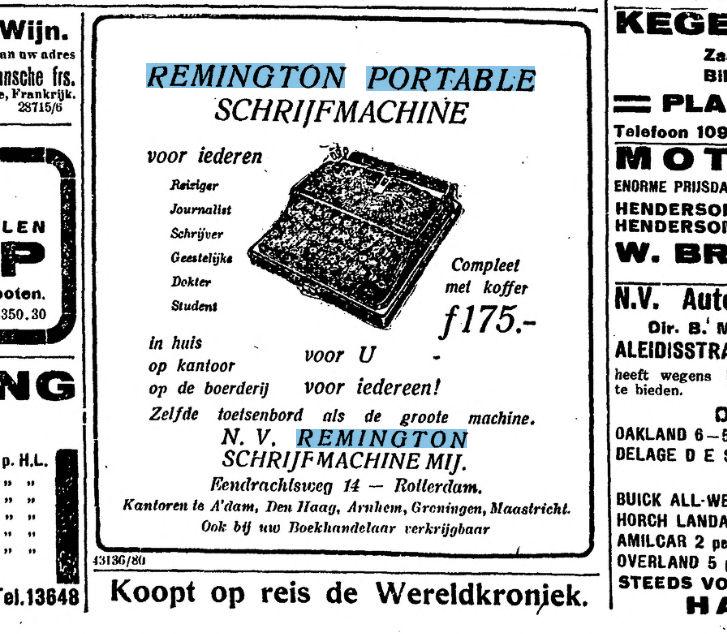
Sperry Remington Idool vs. Remington Portable #2
The typecast below is written on a Sperry Remington Idool (1980) and a Remington Portable #2 (1928). I bought the Sperry last week for 3 euros and even got one week warranty on it.
| Sperry Remington Idool (left) and Remington Portable #2 (right) |
The currency used in the typecast (below) is guilder. The Sperry has a florin sign "ƒ", the Portable #2 with the German keyboard lay-out hasn't, so I used the "Fl"-alternative (it means the same).
| Click to enlarge |
| Above the receipt of last week. Below the original warranty from 1980 |
And the best for last: a really nice video of a Remington Portable typewriter:
01 september 2011
Williams typecast
Abonneren op:
Posts (Atom)
.jpg)


.jpg)